

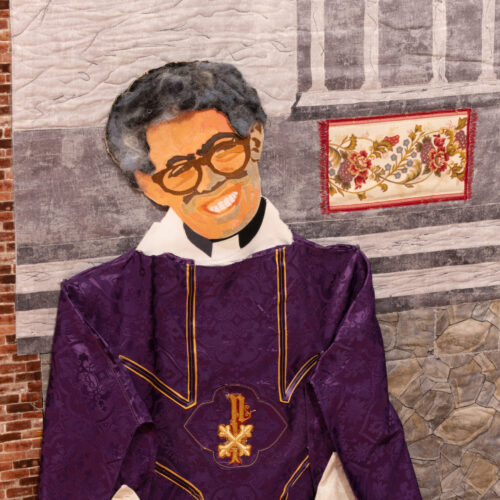
The Reverend Dr. Pauli Murray, Esq.
Anna Pauline “Pauli” Murray was a human rights activist, lawyer, and author. Born in Baltimore in 1910, they were baptized at St. James and would later become the first born-female Black person ordained as an Episcopal priest. Murray had a complex relationship with both their gender and racial identity, and expressed their gender in a way that did not conform to traditional male or female roles. Although not as widely known as other civil rights activists, Murray was deeply involved in the movement through literature, law, religion, and feminism.
Murray worked for the Works Progress Administration and National Urban League, and was active in civil rights demonstrations across multiple states. They were even arrested for refusing to sit in the segregated section of a bus fifteen years before Rosa Parks’ demonstration. Notably, Murray wrote a paper while at Howard University that argued against the “separate but equal” doctrine; their professor who was serving on the legal team for Brown v. Board of Education later shared the paper with Thurgood Marshall, and Murray’s written argument helped inform Marshall’s arguments before the Supreme Court. Despite being continuously turned away from higher education institutions by race or sex-based discrimination, or as Murray called it, “Jane Crow Laws”, they eventually graduated at the top of their class from Howard University, and became the first Black person to receive a Doctorate in Law from Yale University. Murray is another example of someone whose path to greatness was interwoven with The Historic St. James Episcopal Church.