

Risk, Research, and Reward
How the Minute Book of the Committee of Vigilance and Safety Altered My Understanding of the War of 1812
By William Kelly
Post published November 2025

Sometimes, if they are lucky, a researcher will stumble upon something in the archive that stops them in their tracks. When I took a chance on a large, well-worn minute book one day in the H. Furlong Baldwin Library at the Maryland Center for History and Culture (MCHC), it divulged an unexpected story that, luckily, stopped me in my tracks.
I carefully opened the minute book, cradled it between two foam wedged supports, and began reading. “Baltimore 24th August 1814,” the first entry began. “In conformity to the recommendation and resolves of a meeting of a number of citizens … the following persons were duly elected … to form a general Committee of Vigilance and Safety during the present state of alarm.” [i]
The date of the Committee of Vigilance and Safety’s first entry, August 24, 1814, is telling. That same day, the British destroyed nearly every major public building in Washington, DC—including the Capitol and the White House. The War of 1812 continued to rage up the Chesapeake Bay. The threat of disastrous conflict descending upon the city of Baltimore intensified daily. Frustrated with the lack of federal aid, Baltimoreans and those within the city’s hinterlands took matters into their own hands. They formed the Committee of Vigilance and Safety to fortify the city against the impending British attack.
Three civilian men were chosen from each of Baltimore’s eight wards, plus three from a “Western Precinct” and three from an “Eastern Precinct,” to lead barricade efforts, recruit volunteers, and even surveil the city’s population. Richard Frisby, an enslaver and Federalist member of the Maryland House of Delegates, was among those elected from the Eastern Precinct. A native of Kent County, a short ferry ride away on Maryland’s Eastern Shore, Frisby represented Baltimore City’s spanning influence across the Chesapeake Bay. [ii]
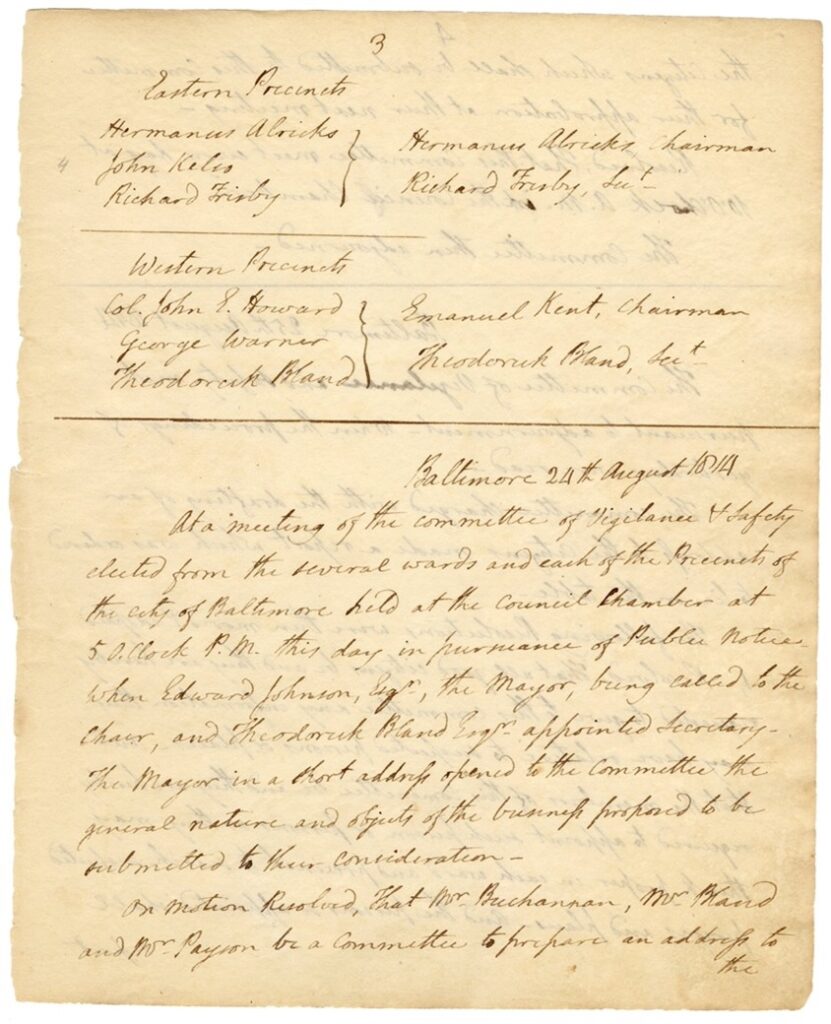
The committee immediately began erecting defense works in various parts of the city. “That the exempts from militia duty and the free people of colour … of the 8th ward and the Eastern Precincts, assemble tomorrow, Sunday morning [August 28], at 6 o’clock, at Hampstead Hill, with provisions for the day,” the committee ordered. Similar defense projects commenced throughout the week at Myers Garden, Washington Square, and at the intersection of Eutaw and Market Streets. [iii]
Soon thereafter, the committee recruited citizens across the city to help in the war effort. “The owners of slaves,” the committee promulgated, “are requested to send them to work … and such of our patriotic fellow citizens of the country, or elsewhere as are disposed to aid in the common defence, are invited to partake in the further duties now required.” The Committee of Vigilance and Safety called on everyone to help defend Baltimore’s freedom—even those whose enslavement excluded them from enjoying that freedom. [iv]
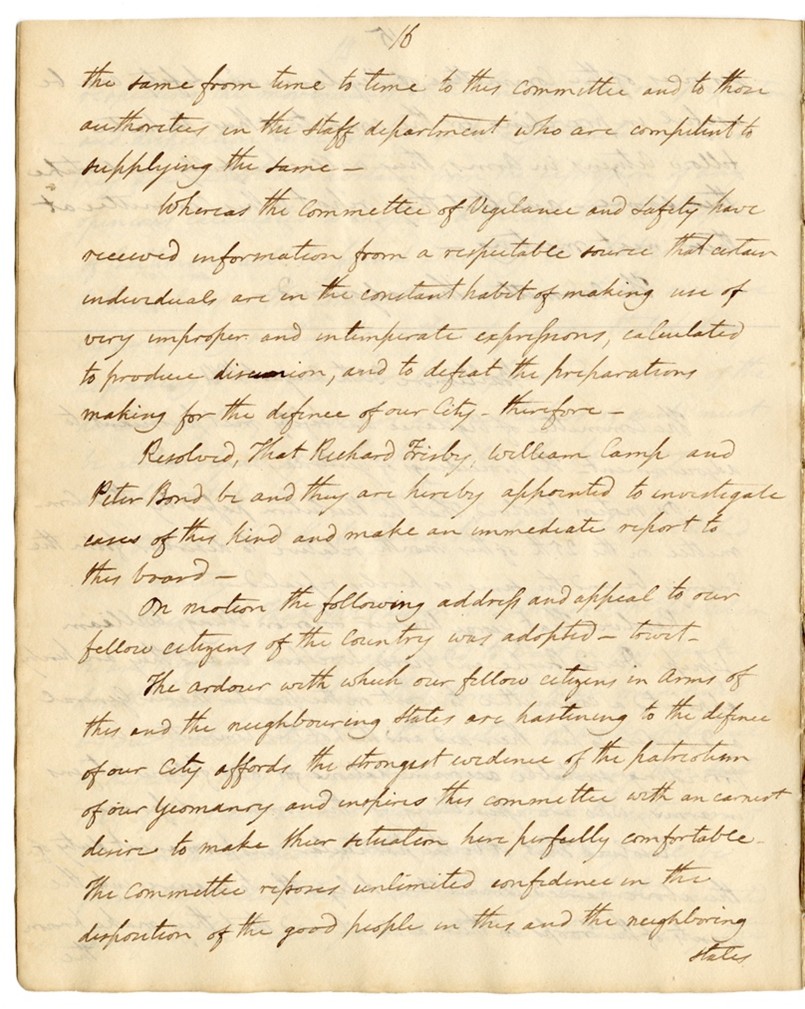
But on August 30, 1814, the Committee of Vigilance and Safety asserted themselves beyond the construction of barricades:
“Whereas the Committee of Vigilance and Safety have received information from a respectable source that certain individuals are in the constant habit of making use of very improper and intemperate expressions, calculated to produce discussion, and to defeat the preparations making for the defence of our City—therefore—Resolved, That Richard Frisby, William Camp, and Peter Bond be and they are hereby appointed to investigate cases of this kind and make an immediate report to this board.” [v]
War almost always brings with it a frenzy and paranoia that risks infringing upon citizens’ privacy. The Committee of Vigilance and Safety’s very existence reflected those feelings. As a result, the committee appointed Richard Frisby and two other civilians to surveil and investigate any individual who spoke ill of the United States or, conversely, spoke positively of Great Britain.
Frisby and his colleagues soon discovered a potential traitor. The investigators charged Joseph Presbury, a Justice of the Peace in Fells Point, with “high censurable” conduct. Presbury, in their view, expressed “sentiments unworthy of an American Citizen”:
“That he has on a very recent occasion rejoiced at the difficulties and embarrassments into which he expected our Government would in all probability be thrown and manifested pleasure at the powerful reinforcements which the Enemy were pouring into our Country. Your Committee further beg leave to represent that, the general character and deportment of the said Presbury appears to be marked with the strongest impropriety, that, it has a tendency as far as his influence may extend to damp the ardour of our patriotic citizens in defence of our City, and is highly derogatory to an officer holding a commission for the State or Maryland. Your Committee consider it as one of those cases which calls for the interposition of your Board, but leave it to your wisdom and judgement to mark out a proper course to be pursued—All of which is respectfully submitted—Richard Frisby, Chairman.” [vi]
The Board consequently sent a copy of Frisby’s report to Maryland governor Levin Winder, asked for his consideration of the matter, and advocated that Governor Winder “remove the said Presbury from the office of Justice of the Peace.” [vii]

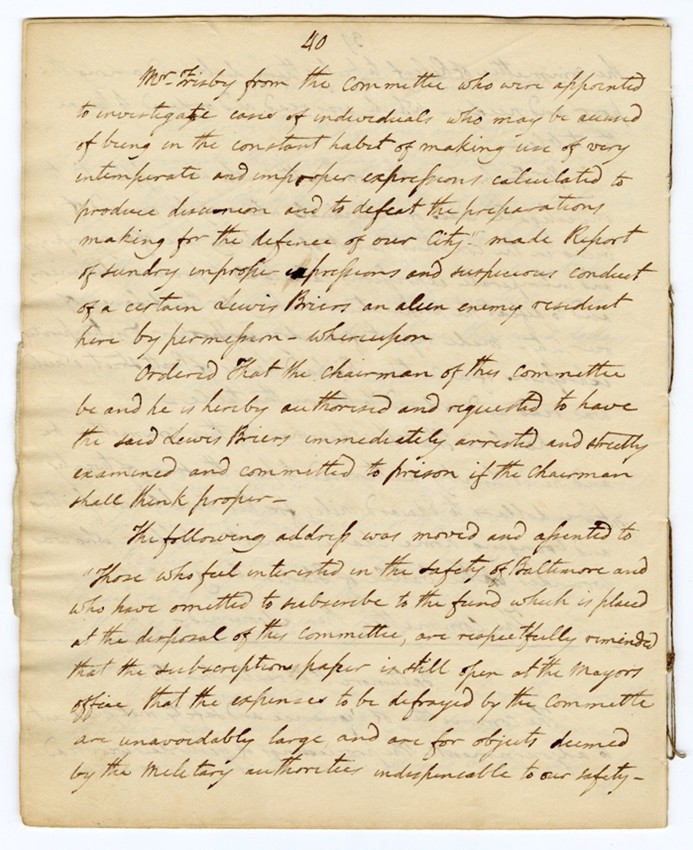
On September 9, 1814, a few days before the British arrived at the mouth of the Patapsco River, Frisby reported to the committee another possible case of treason. Frisby accused “a certain Richard Lewis of Pratt Street” of “very improper and intemperate expressions calculated to produce disunion.” The following day, Frisby brought forward a similar report on Lewis Briers, “an alien enemy resident here by permission.” The fate of Richard Lewis is not recorded in the minute book. Lewis Briers, on the other hand, faced serious trouble. Although they do not describe in detail the exact allegations against Briers, his status as an “alien enemy” likely contributed to the committee’s feverish request “to have the said Lewis Briers immediately arrested and strictly examined and committed to prison if the Chairman think proper.”[viii]
But while Frisby conducted his investigations into possible “un-American” activity around Baltimore, an entirely different drama unfolded at his Kent County plantation.
According to documents at the National Archives and Records Administration, on August 29, British forces sailed into Kent County’s Fairlee Creek to investigate suspected American troop movements. They returned on the morning of August 30—the same day Frisby was selected to investigate treasonous activity in Baltimore—and landed at Frisby’s plantation. Chaos ensued as the British came ashore. Amid that chaos, William, Ephraim, Solomon, and Peregrine—four young men enslaved by Frisby—escaped to the British. Newly freed and under British protection, the four freedom seekers sailed out of Fairlee Creek and back to the British anchorage off nearby Pooles Island. But they were not gone for long.
On the evening of August 30, 1814, the British returned to Fairlee Creek once more. But this time they were guided by one or more of William, Ephraim, Solomon, and Peregrine. The freedmen informed the British of American troop sizes and locations. Emboldened, the British landed in Kent County intent on a surprise attack based on this new intelligence. Around midnight, one or more of the freedmen piloted 124 British troops five miles into the Kent County interior providing a knowledge of the local geography and terrain previously unpossessed by the British forces. [ix]
What followed was the Battle of Caulk’s Field—one of the few American victories in the Chesapeake during the War of 1812. Despite the British loss, American officers were perplexed by the ability of the British to locate their camps. One American officer, Captain Ezekiel Foreman Chambers, recalled later:
“A most important movement of Captain Parker into an intricate position at or about midnight was currently said to have been effected by the aid of these very negroes of Mr. Frisby who were stated to have been brought ashore to direct him to our camps. This statement was I know credited by many of our people who could not ascertain any other mode by which information so accurate as the enemy certainly evinced, could have been obtained.” [x]
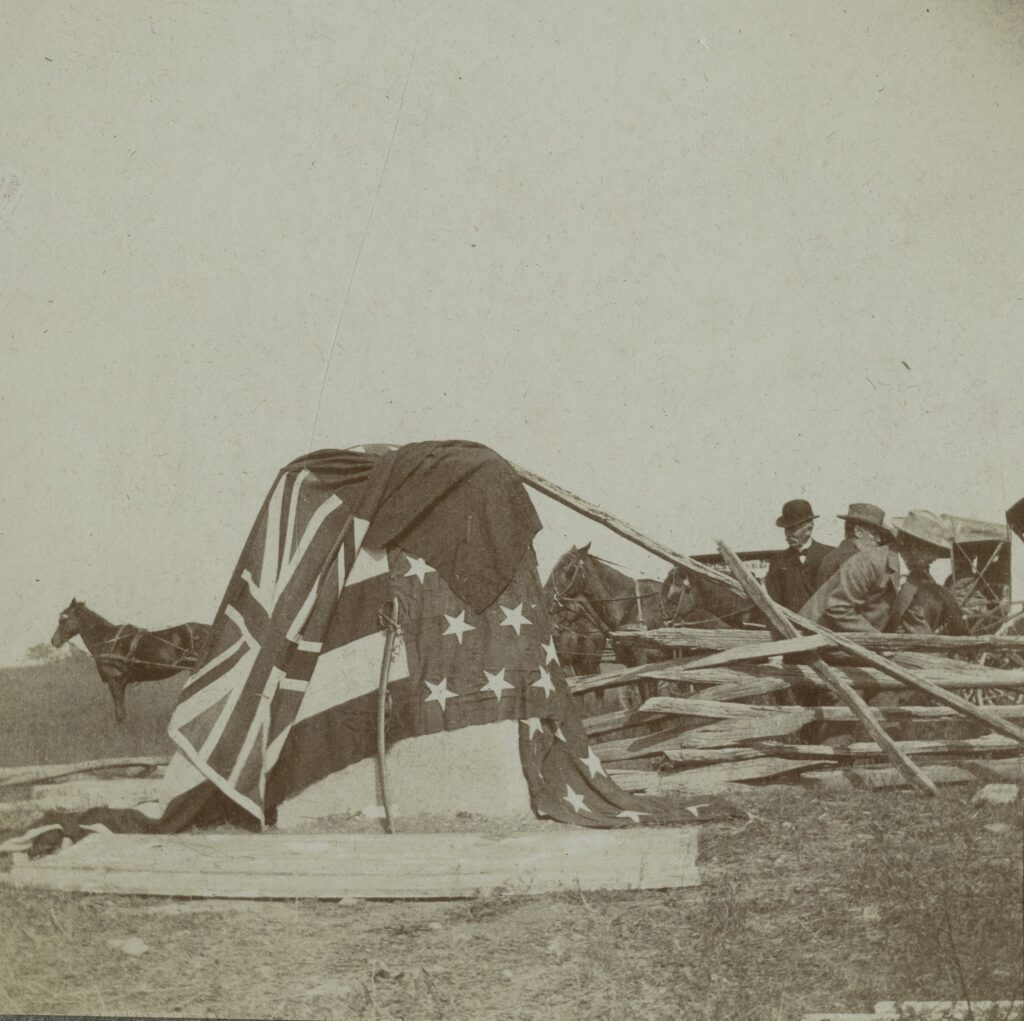
Like his peers across Maryland, Frisby did not simply shrug his shoulders when he learned that four men escaped his enslavement. Instead, he enlisted the help of Baltimore banker James A. Buchanan, with whom he shared a seat on the city’s Committee of Vigilance and Safety. Between the Battle of Caulk’s Field on August 31 and the bombardment of Fort McHenry on September 12, Buchanan visited the British fleet under a flag of truce equipped with Frisby’s “application” to Vice Admiral Alexander Cochrane for the “restoration” of his enslaved men. But William, Ephraim, Solomon, and Peregrine had already descended the bay aboard another British vessel. William, Ephraim, Solomon, and Peregrine remained free men. [xi]
Believe it or not, being a historian involves taking risks. That next piece of information that helps make your research whole might be in the next volume you pull. Or it may not. That’s the risk. It is not a waste of time to view material that you feel might contain research-altering information only to find out that that source has nothing to do with your research at all. Frustrating? Absolutely. A waste? Absolutely not. To discover that what you are looking for is not in a particular place is time well spent. But when you do take that risk and hit upon a source that brings a new dimension to your research—it is the historian’s euphoria.
I was fortunate enough to experience that odd elation in MCHC’s Library. The minute book of the Committee of Vigilance and Public Safety gave me insight into the social and political environment of wartime Baltimore. Moreover, it provided invaluable evidence that informs the story of William, Ephraim, Solomon, and Peregrine’s escape from Frisby’s enslavement. Now that I know where Frisby was and what he was doing when William, Ephraim, Solomon, and Peregrine guided the British ashore in August 1814, it connects their escape even more tightly to our broader history of the War of 1812.
William F. Kelly, PhD, received his doctorate from the University of Nebraska-Lincoln in August 2025. He was the inaugural Ashby M. Larmore Fellow at the Maryland Center for History and Culture in the 2023–2024 academic year. He is now a research archivist at the Maryland State Archives.
The Ashby M. Larmore Research Fellow was established to foster and expand genealogical and historical knowledge related to the Eastern Shore of Maryland and to honor the late Mr. Ashby Morton Larmore’s dedication to continual learning through primary source study.
[i] “Civilian Defense in Baltimore, 1814–15: Minutes of the Committee of Vigilance and Safety,” 24 August 1814, MS 1846, H. Furlong Baldwin Library, Maryland Center for History and Culture, Baltimore, 1-5; Two political scientists define vigilance committees as “formal or informal coercive groups organized to establish law-like claims in a manner that is not officially sanctioned by the state.” For more on vigilance committees in United States history, see Jonathan Obert and Eleonora Mattiacci, “Keeping Vigil: The Emergence of Vigilance Committees in Pre-Civil War America,” Perspectives on Politics 16, no. 3 (September 2018): 600–616; Larry Bowman, “The Virginia County Committees of Safety, 1774–1776,” The Virginia Magazine of History and Biography 79, no. 3 (July 1971): 322–337; Jesse Olsavsky, “Women, Vigilance Committees, and the Rise of Militant Abolitionism, 1835–1859,” Slavery & Abolition 39, no. 2 (2018): 357–382; Bethany Nagle, “The American Protective League and White House Security During World War One,” White House Historical Association, 26 April 2017, https://www.whitehousehistory.org/the-american-protective-league-and-white-house-security-during-world-war-one; Vernon L. Pedersen, “Memories of the Red Decade: HUAC Investigations in Maryland,” in American Labor and the Cold War (Rutgers University Press, 2004): 177–189.
[ii] “House of Delegates,” Maryland Gazette, October 24, 1811; “The Unanimous Address of All the Federalists Who Met at the Late Session of the Legislature, to Their Constituents,” Maryland Gazette, July 2, 1812; “Big Fairlee,” Architectural Survey (Annapolis: Maryland Historical Trust, 1977, 2004).
[iii] Minutes of the Committee of Vigilance and Safety, August 26, 1814, 7–12.
[iv] Minutes of the Committee of Vigilance and Safety, August 30, 1814, 19.
[v] Minutes of the Committee of Vigilance and Safety, August 30, 1814, 15–16.
[vi] Minutes of the Committee of Vigilance and Safety, August 30, 1814, 23–24.
[vii] Minutes of the Committee of Vigilance and Safety, August, 30, 1814, 24.
[viii] Minutes of the Committee of Vigilance and Safety, September 9, 1814, 38–40.
[ix] “Case Files, ca. 1827–ca. 1828,” Record Group 76: Records of Boundary and Claims Commissions and Arbitrations, PI 177 190, National Archives and Records Administration (College Park, MD): Box 9, Case 862, Frisby, Richard.
[x] Case Files, ca. 1827–ca. 1828, NARA, Box 9, Case 862, Frisby, Richard; “The Following Facts Are Gathered,” Maryland Gazette, September 8, 1814; “Wilmington (D.),” Maryland Gazette, September 8, 1814.
[xi] Case Files, ca. 1827–ca. 1828, NARA, Box 9, Case 862, Frisby, Richard; Minutes of the Committee of Vigilance and Safety, 26 August 1814, 3–4; James A. Buchanan was president of the Office of Discount and Deposit in Baltimore and, along with four other men, controlled the Baltimore branch of the Bank of the United States. By 1817, one scholar notes, Buchanan became “one of the nation’s leading commercial figures,” and his name was being floated to lead the Bank of the United States. Soon thereafter, the unsavory lending practices that made Buchanan and his partners wealthy and powerful came crashing down in the landmark Supreme Court ruling, McCulloch v. Maryland (1819). For a fuller explanation of these events, see David S. Bogen, “The Scandal of Smith and Buchanan,” Faculty Scholarship (1985): 125–132; James A. Buchanan, Robert Goodloe Harper, James W. McCulloch, An exhibit of the losses sustained at the office of discount and deposit, Baltimore, under the administration of James A Buchanan, president, and James W. McCulloh, cashier (Baltimore: Thomas Murphy, 1823).